
Grow, Grow, Grow!
How venture funding is becoming democratized

What’s up my 23 subscribers 🤝 (155% WoW growth!)
If you haven’t subscribed:
and welcome to the second edition of shitweekly, a weekly newsletter where I take a deep dive into startups, their founders' successes and failures, and all the shit in between.
This week we will be taking a deep dive into the VC world & Seedscout, a platform that helps founders raise seed money and empowers them to embrace an outsider personality.
Something to keep in mind: I’m not an expert on any of these topics. I’m here to learn as much as you. With that being said, if you don’t know what Seedscout is, take five minutes to become more familiar with their business and then read this.
If you know someone that would like this newsletter, share it with them below
As we do so many times at shitweekly, to understand why Seedscout exists, we have to understand the inner workings of Silicon Valley and reverse engineer this article.
Note: I want to preface this article with that I don’t think Silicon Valley is evil. The innovation and pure talent that has congregated there over the past few decades is very much inspiring and should be recognized. But, I also believe that great entrepreneurs and builders not in Silicon Valley don’t have the same shot as someone who is. That’s not to take anything from well-connected people in SF but talent lives everywhere and accessing it is becoming a huge market.
Silicon Valley from an outsider's perspective
Let's run some numbers real quick. 99% of businesses won’t ever receive venture funding in their lifetime & for two reasons: Most businesses can’t give an investor a 3x or 10x return, and/or they never can get into the room with an investor. The math just doesn’t work out
The 1% that does receive funding is split into two groups:
Insider led companies
Outsider led companies
Insider-led companies are automatically shown the best investors, welcomed with a warm intro, and written a check within a few weeks/months. This is for good reason. The investors know them and know that their money is safer than some joe schmo off the street. Let me be clear that these people deserve it. They worked their ass off to get on the inside and most likely will become successful in some way. But there is a whole market of first-time founders or founders who had a rough go the first time and are not represented in this group.
Outsider-led companies make up the rest of the group and are left to fend for themselves, all going after the same investors and trying to scramble for capital. If they can’t secure funding they either go out of business or give up such a large chunk of their company that, as Mat puts it, “fucks their cap table.” But, if an outsider raises from an insider in SF, that outsider has just passed through the gates. They are now exposed to the best resources and capital in the whole world. If you are a founder and have done this, congrats! (also dm me)
How VCs make money
VCs allocate capital by reaching out to insiders and asking them to invest in their fund. These insiders might be successful founders, VCs, or influential people who have had exits/knowledge in a specific space. If they invest, they become an LP (limited partner) and usually expect a 3x return on their investment. But most funds don’t even produce a 1x return. Most companies VCs throw money at go under and if the LP doesn’t like where their money is going, they can pull their capital out, or in other words fire the VC. To combat this, VCs will throw money at such a wide range of ventures because if 99% fail but just one startup gives them a 100x return then their fund can survive.
Since VCs are in a constant game of picking winners and losers, they need to maximize their chances of winning and keeping their job. So, how do they pick them? How do they decide who the insiders and outsiders are? This is called deal flow.
Deal Flow & how it works
If you're a VC, you're getting pitched all the time; from legit entrepreneurs who have been referred to you, to people cold emailing you about a revolutionary idea they have just thought of while sitting on their parents’ basement couch. Your email is filled with companies that can 100x your money or drain your fund. All these referrals, cold emails, or any type of ‘pitch’ is called deal flow.
Warm intros (the insiders): These are referrals from other founders, other investors, and insiders in the industry. These people are well connected within SF.
Cold intros (the outsiders): Think of a cold intro as someone on Shark Tank but it is over email instead of in person. You have one chance to catch the investor's attention before they click delete on your pitch, and that’s if they can find the email.
Mat explains this perfectly:
“If an investor has 1,000 deals to look at one week, and 500 of them came from warm intros, and 500 of them are cold emails, where will they look? Obviously the better source of deal flow.”
Breaking in and getting a warm intro shows that you and/or your company is special and that an investor believes in you. This is essential to your company's survival and to boost later funding rounds. If one insider shows interest in you, that means that there will be more to come. In Silicon Valley, people do business with others they trust. (That's just how business is done, period.) If two investors have similar hypotheses and one of them invests in your company, the other most likely will follow.
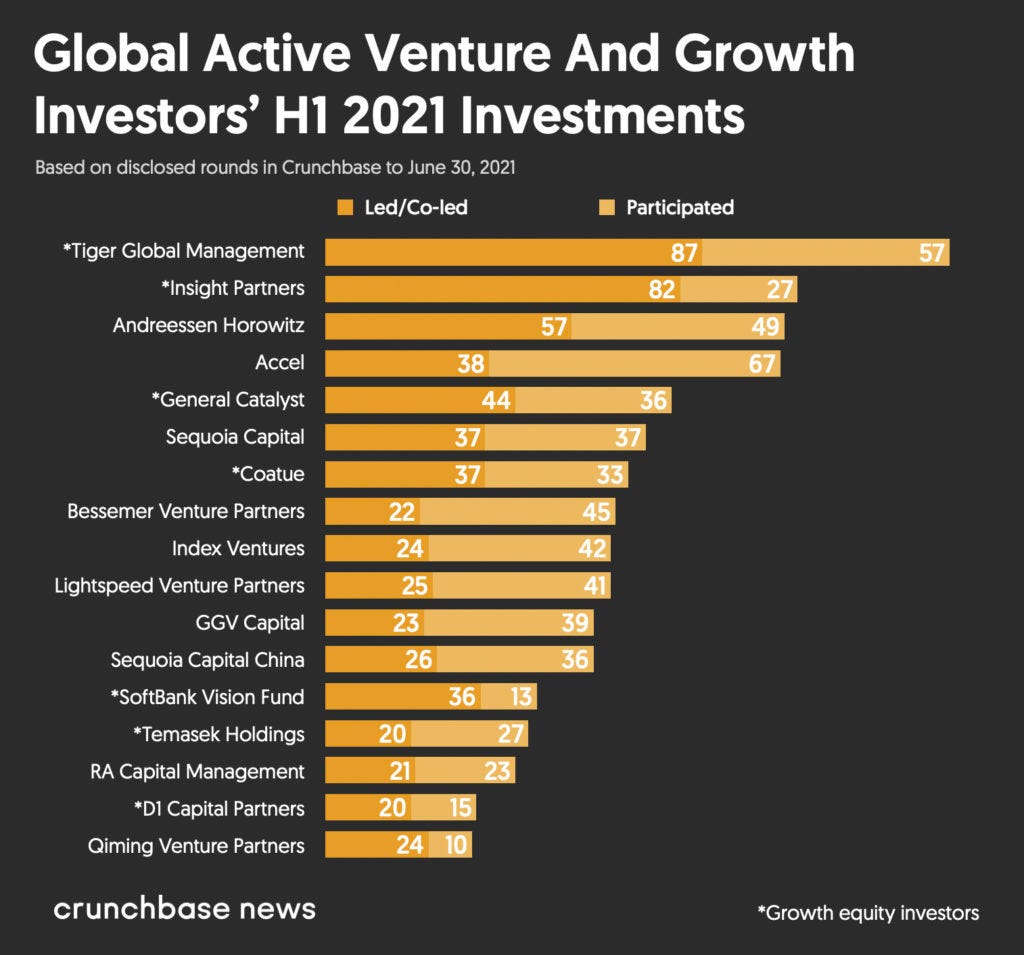
This all factors into the numbers game these VCs are playing. If one VC misses out on the next Uber or Airbnb by not throwing a 25k check into the pot at the early stages, they probably won’t keep their job. So, they throw money everywhere and see where it sticks. One of these players who has done this at a rapid rate recently is Tiger Global. I can’t even give an up-to-date number on how many companies they’ve funded this year because they close a deal a day, but here is a graph showing their monster year to date as of H1 2021.
What VCs want
Silicon Valley is a place of magic and mystery. VCs make a career off taking oversized bets on very small startups with crazy ideas. Look back on very successful Silicon Valley startups and most of the billion-dollar exits or IPOs have been bets on crazy ideas and founders that seem stupid but end up making perfect sense.
“VCs want outliers. They want outsized returns. They want ownership. But 80% of them are going after the same 20% of the deals and it's because I don’t think they know how to find these high-quality founders in Kansas and Maine. It's just easier [for VCs] to invest in warm intros.”
Warm intros are the industry standard. There is no incentive for a VC to step out of the pack and invest in a cold intro because historically they have not proven to give the same returns as a traditional SF startup.
So what is a VCs Philosophy?
VCs are what PackyM would describe as ‘shotcallers’. They find a big market, expand rapidly, and guarantee goals. Uber or WeWork would be examples of this with their large spending, exponential growth, and former CEOs.
“In sports, Shotcallers become legends. In startups, they become cautionary tales. In startups, Worldbuilders are the ones who become household names.”
SF is changing year by year
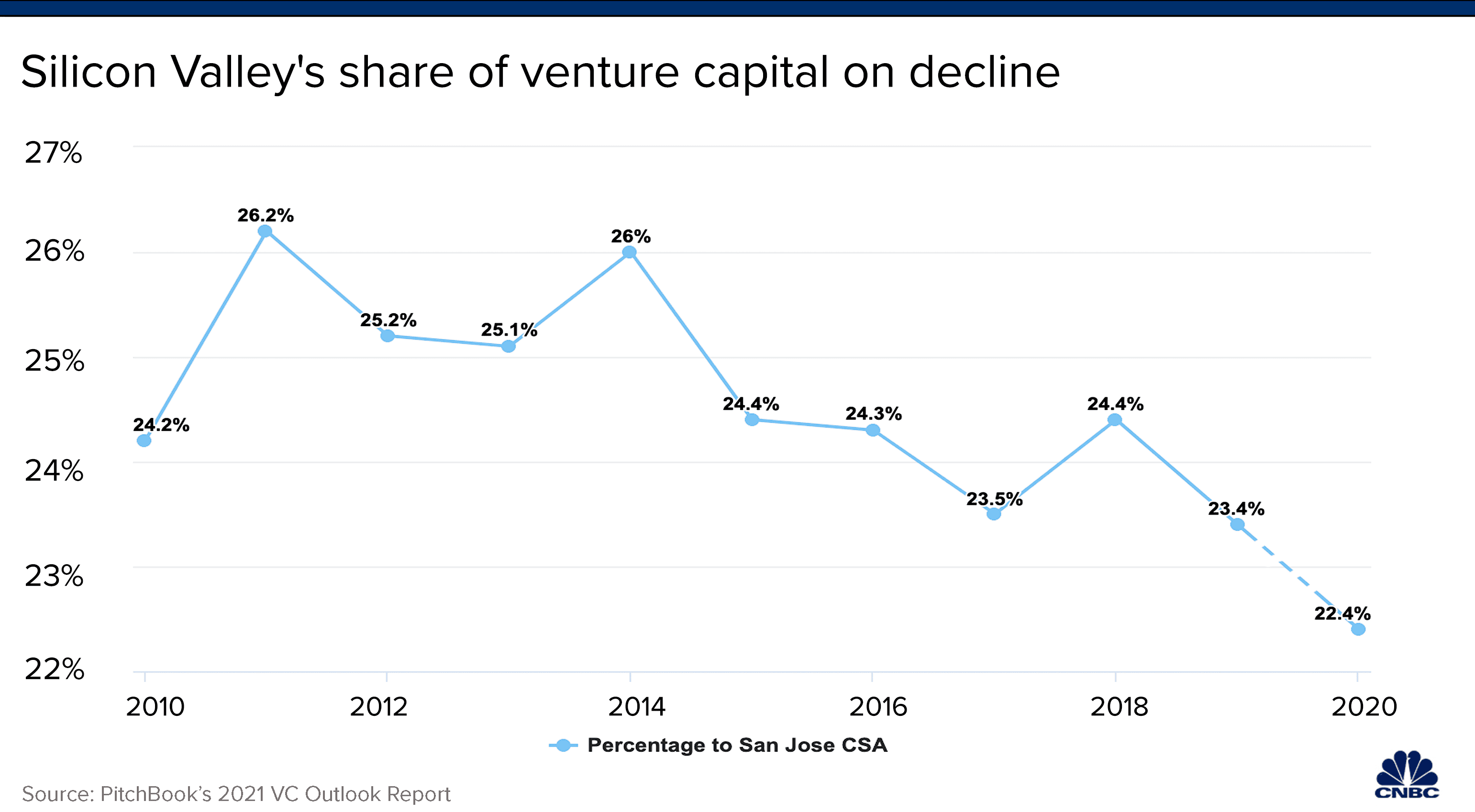
When I say that capital is transferring out of SF I don’t mean that SF is “dead” or whatever shit posters on Twitter say. I am simply saying that SF is not as powerful as it used to be. Look at this chart of the past ten years of the percentage of venture capital in SF. I’m referencing this because I believe if you extend that graph ten, twenty years you will see the percentage go much lower, and for two reasons:
Innovation is everywhere
Silicon Valley works against itself
Innovation is everywhere. The internet itself has decentralized so much of society that we don’t need to be in the same place anymore to communicate or share ideas. The prime example of this is covid but this paradigm shift has been at work for a decade now.
Silicon Valley hurts itself. Have you ever heard of the argument that the new product Apple creates cannibalizes the old product, creating an ever need for more innovation and new products that people ditch only after a few years? If not, it goes like this:
After Apple released the iPod Mini, it created the iPod Nano, effectively destroying the revenue stream for the original product, and completely shifting their focus. This was then followed up by the iPod touch and then the iPhone. I don’t believe in this theory fully but it brings up an interesting point: The products that Silicon Valley creates lowers the entry point for people and companies to break into the tech industry.
Twitter, Substack, and Zoom are prime examples of this. I don’t have to be a writer at a newspaper or be a reporter for a big media company to get my ideas out. I can simply startup a Substack, publish my ideas and share with whoever I want. On Twitter, I can connect with people, grow my network and organically break into whatever industry I want. If I want to raise money, I don’t have to fly out to SF anymore and go door to door, getting denied from investors. I can just schedule a zoom meeting. But, I’m an outsider. There has been no better time to raise money than right now but most companies can’t break into Silicon Valley.
Enter Seedscout
Now that we have described the VC world and how it works, I want to introduce Seedscout, a database of pre-seed and seed startups overlooked by most investors that is helping democratize funding and transfer the power of the fundraising process back to the founder.
In 2018, Mat was denied from YC for the sixth time. He wasn’t deterred though. He started a podcast called Forward Thinking Founders, interviewing founders in order to network. Mat wanted funding. He wanted a VC to believe in his idea because to him at the time that classified him as an insider and carved out a path to success.
700 episodes later, Mat has personally identified billion-dollar companies at the seed stage and went up against the beast that Silicon Valley is. He is determined to change the system and create a more fair playing field for startups and their founders.
Seedscout is a very mission-led company and if you ever get the chance to talk to Mat or read one of his Twitter rants, he tends to be a very passionate guy. This is for good reason as Mat is trying to beat VCs at their own game: being the first investors in the door. Being the first point of contact for startups is crucial to Seedscout’s success. If they can get the startup to buy in and list their data on Seedscout, it creates a chicken and egg dilemma, forcing VCs and firms to be on Seedscout to see what is hot/not.
How Seedscout works
Seedscout works in a couple of ways. Let's examine the three parts that make it special:
Seedscouts system
Investor side
Founder side
Seedscout’s system. Seedscout acts as a database layer between seed investors and startups. It does not directly invest in companies and is not a VC firm. Using filters, it sorts companies and lists data provided by the founders so that investors can dig through and ‘scout’ companies.

Investor side. Investors in the database are given a Seedscout score, which is an internal tool that Seedscout uses to determine how good a job a VC is doing. This provides more transparency for the founder since they can see if the VC is legit or just looking for a quick buck.
Here is an example of a company profile on Seedscout that investors can look through and make a determination of investing:
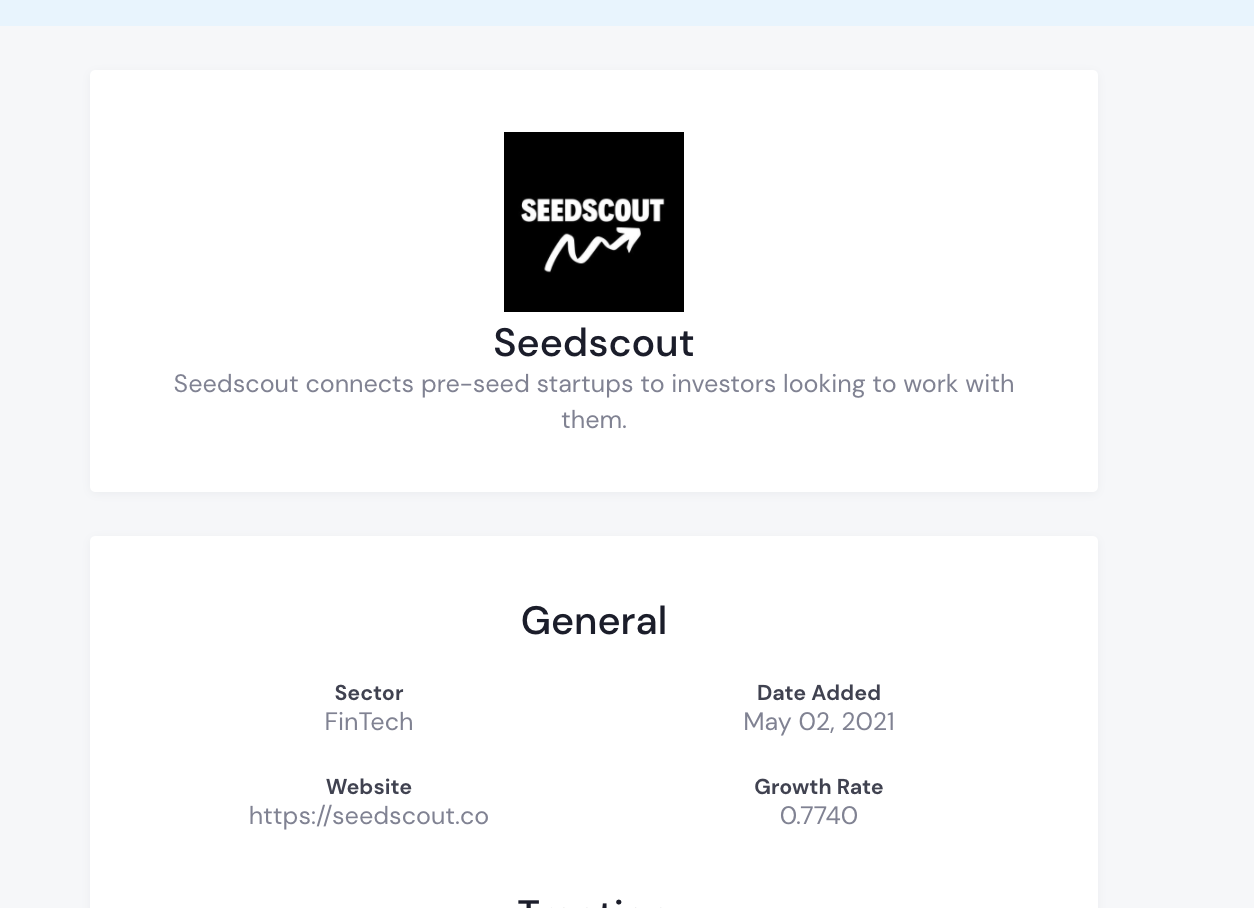
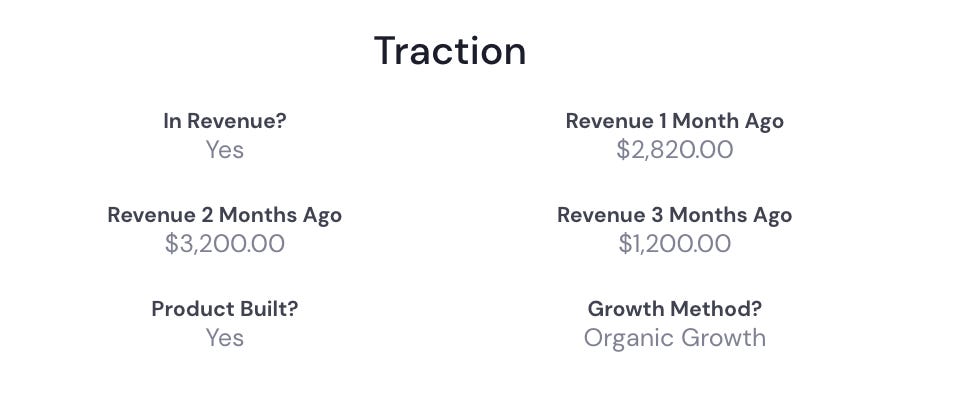
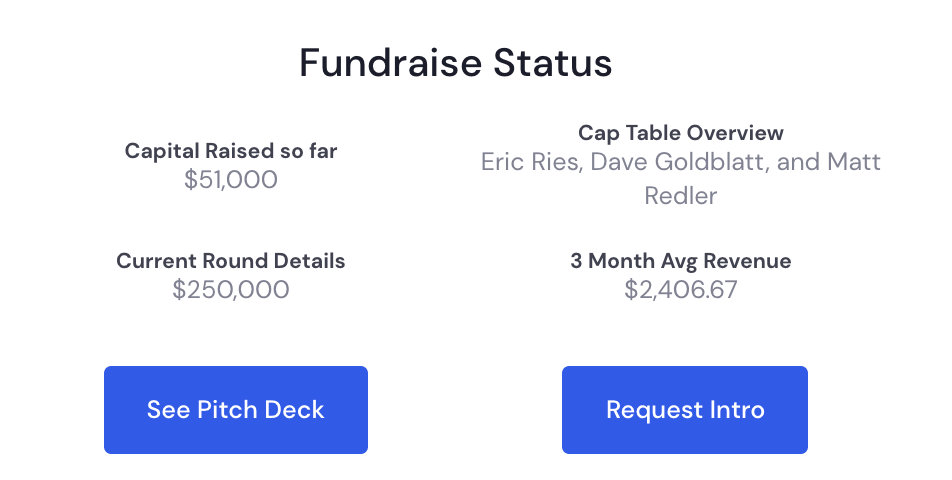
Founder side. Founders are prompted to give their data of their startup to be listed in the system. (this is what you see above). This is contrary to sites like Crunchbase or Zoominfo where they scrape data across the web and then charge a monthly subscription to access it. For later-stage companies this works pretty well since there is lots of data to scrap and go through, making it more accurate for investors looking to invest. But with pre-seed and seed startups, especially ones on the outside of Silicon Valley, there is little to no information about them on the web, causing the big data scrapers to overlook them.
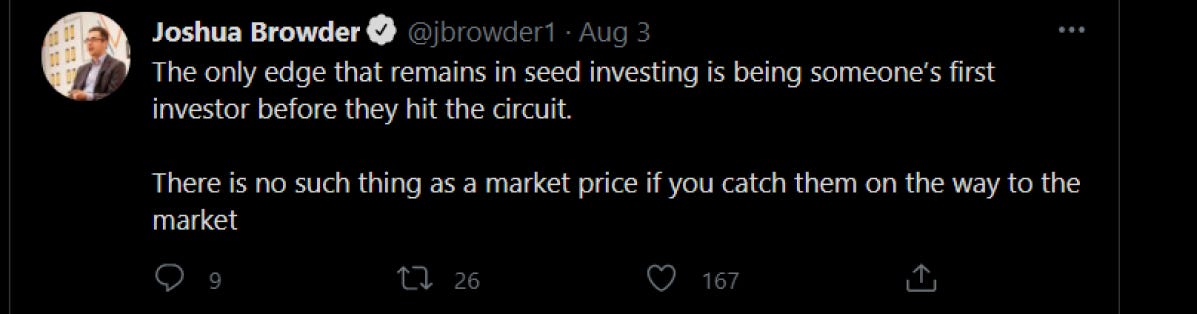
But isn’t this where the big money is made? Yes. For a seed/angel investor to hedge his losses and create a big return for his LP, they want to be one of the startup's first investors and then tell their friends about it. No one wants to be the last one in the round and left holding the bag if the company goes under. This is how a VC gets fired. They need to be quick, which is good for Seedscout as investors will be more willing to adopt their tools and be on the platform just for the sheer fact that they don’t want great companies slipping through their fingers.
How Seedscout makes money
Most ‘scouts’ for VC firms or referrals come with a small piece of equity in the deal. Say I brought a VC a company and they invested: I would get a small piece of the equity since I brought them the deal. This is called carry and it is the traditional way of paying scouts.
On Seedscout, only investors are charged $50/month for access. Mat scouts a company and then refers the VC to them with no carry obligation. On the founder side, they are selling access to investors and their capital. Investors are interested because they can find great companies with no carry.
Seedscout’s Future
As of this week, Seedscouts MRR is $2,550, the number of scouted companies remains undisclosed, and it is just Mat doing the scouting. Do I think it will survive and become a billion-dollar company? Who can tell? But what I will say is that there will be a company that democratizes startup funding and gives more power to the founders. I am 100% certain of this for all the reasons listed above.
In Conclusion
Although I might not agree with all of Mat’s Twitter rants and wanting to destroy the system, I will say that there is a large market of overlooked startups outside the Bay Area waiting for funding, and whichever company can tap into that space will be very successful.
Silicon Valley should judge on the founder's idea not play a who knows who game. I think that VCs would generally agree with this statement but they can’t go searching for every founder or email to find a diamond in the rough; they simply don’t have enough time. And with tools like Seedscout, it encourages founders to raise money and test the market for their products while exposing them to investors.
I don’t see Silicon Valley’s piece of the pie getting smaller, I see the overall pie growing larger and including even more wacky and sometimes risky ideas & bets. That’s what building and funding a startup is all about. Sometimes you lose, sometimes you win but at the end of the day you learned and met great people, no matter where the money came from.
Loved this article?